Booster Pump Installation adds a properly sized pump for homes or properties needing more water pressure; pump capacity and electrical work shape the typical $1,000–$3,500 range.
Water Pressure Suddenly Dropped Throughout Your Michigan Home?
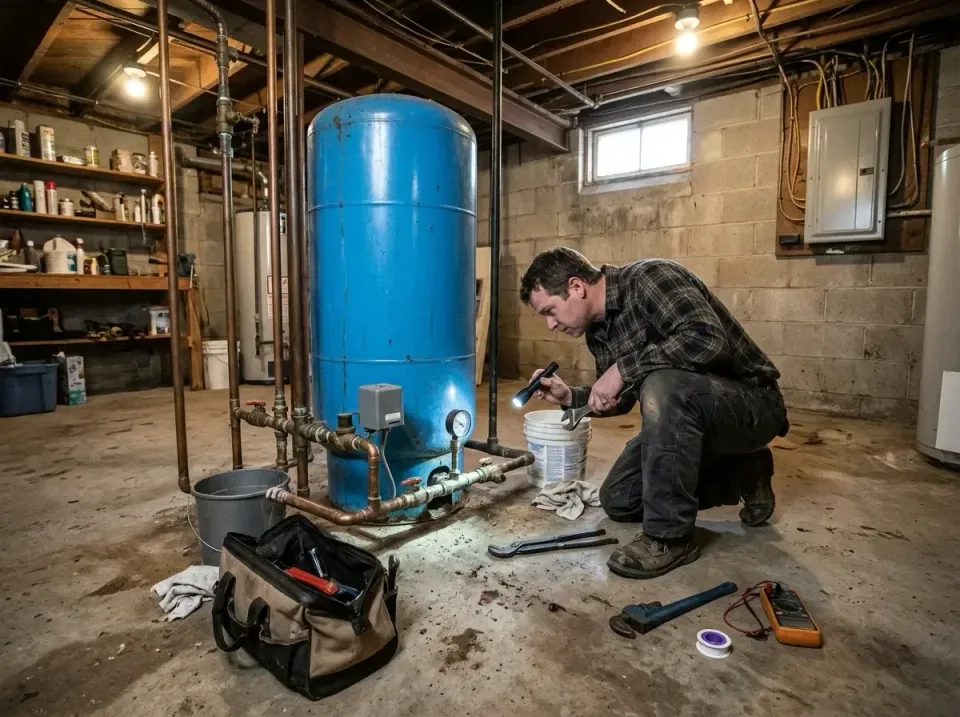
Why Did Water Pressure Suddenly Drop Across Your Michigan Home?
A sudden, house-wide pressure drop points to a supply, valve, or plumbing problem not just one troublesome faucet. Start by checking whether cold and hot water are affected at several fixtures, then look for visible leaks and ask nearby neighbors whether their water changed too. A frozen service line may restrict the water entering your home, so Michigan cold snaps deserve attention if the drop follows freezing weather.
On homes near the Lake Michigan shoreline, winter conditions can make outdoor service-line access harder, so note where the line enters before arranging a visit. Hot summers also raise cooling demand and outdoor water use; watering or other heavy use can expose a supply limitation.
40–80 psi is a useful residential reference range. We test before recommending a repair. Sudden changes are worth tracing.
What Does a Sudden Pressure Drop Across the Home Suggest?
When several fixtures lose flow at once, start with the shared supply path rather than replacing faucet parts one by one. Our water supply troubleshooting begins by checking whether the problem affects both hot and cold sides, then examining accessible shutoffs, the regulator, and the supply entering the building.
A valve that is partly closed or a failing pressure regulator can restrict multiple fixtures. A leak or obstruction farther upstream can do the same.
The water system serving a home near the Port Huron Blue Water Bridge may have a different source and equipment arrangement than a private well property, so we first establish how that building receives water. That distinction keeps the diagnosis focused.
If only one fixture is weak, a whole-home fault is less likely; if every tap changed suddenly, the shared system deserves prompt inspection. We confirm findings before discussing work.
Could a Pressure Regulator Be Causing the Drop?
A pressure regulator controls incoming pressure. If it fails or is incorrectly adjusted, pressure may fall throughout the house even while the supply outside is unchanged. Do not turn the adjustment screw blindly. Regulator adjustment must stay within the manufacturer’s limits; excessive pressure can strain plumbing and fixtures, while too little leaves taps and showers underpowered.
We compare pressure readings and check the regulator’s condition before recommending adjustment or replacement. Michigan State Capitol visitors and Lansing residents alike rely on ordinary household fixtures, but the practical question at home is whether the incoming pressure is stable and whether the valve responds as intended.
If a home’s readings change sharply during water use, we also check for a restriction or a supply problem rather than assuming adjustment will solve it. The aim is comfortable, consistent flow without overpressurizing the system.
When Should You Call a Plumber Instead of Troubleshooting?
You can check that an accessible shutoff is fully open and compare several fixtures. Stop there if you see water around the meter, hear continuous running, or find a valve that will not move safely. Avoid opening pressurized equipment or making electrical adjustments to a well system; a wrong move can turn a pressure complaint into a leak or equipment failure.
A household near Western Michigan University in Kalamazoo may have different plumbing ages and supply arrangements from another Michigan home, but the decision rule is the same: broad, sudden loss calls for a shared-system diagnosis. Our crew measures pressure and confirms the source before proposing a repair.
For a shower-only symptom, see why shower pressure drops when faucets run in Detroit homes. For a broad change, water pressure diagnosis is a useful next step. Bring the timing of the drop and affected fixtures to the appointment.
What Restores Whole-Home Pressure Comfort?
The repair depends on what testing finds: a regulator may need service, a restricted line may need repair, or a well system may need attention. Whole-home pressure comfort means restoring usable flow at everyday fixtures without masking the cause with added equipment. A booster pump is not the automatic answer; it should only be considered after the building’s supply and existing equipment have been checked.
We explain the findings and options before work begins, then verify pressure at fixtures after an authorized repair. Near the Michigan Maritime Museum in South Haven, a home’s water system still needs diagnosis based on its own supply and piping not on location alone.
If a pressure change began after nearby plumbing work or a shutoff was used, share that detail; it can help narrow the investigation. We protect the home during access and keep the repair scope tied to the measured problem.
Which Repair Option Fits a Sudden Pressure Drop?
The right repair depends on where pressure is lost: at the incoming supply, a control valve, a well system, or one restricted line. At Michigan Stadium in Ann Arbor, building demand is not the same as a household fixture load, so equipment choices should reflect the home’s actual system. A regulator adjustment stays within manufacturer limits; it is not a substitute for diagnosis.
| Option | Best for | Key detail |
|---|---|---|
| Municipal supply check | Several fixtures lose flow on a street-main-fed system | Compare readings at the home before deciding whether the problem is internal. |
| Private well pressure repair | Pressure changes in a pump-fed home | Check the well equipment and tank before selecting a replacement. |
| Regulator repair | Incoming pressure is restricted or unstable | Regulator connections commonly measure 3/4–1 inch; adjustment must follow manufacturer limits. |
| Booster pump installation | Supply diagnosis shows added pressure is appropriate | A typical system may provide 5–20 gallons per minute; size it to flow and pressure needs. |
| Clogged water line repair | A restricted line is identified | Repair the affected run rather than adding equipment to compensate. |
If hot water alone is weak, ask for hot-side diagnosis rather than assuming the whole building supply has failed.
How Should You Prepare for a Michigan Pressure Check?
If water pressure suddenly drops throughout your home, note which fixtures changed and whether the problem affects hot, cold, or both. A private well adds pump and tank equipment to the inspection. A water quality screening may also be appropriate if there is a separate concern about the well water; it does not replace pressure testing. Take these steps before the visit:
-
Locate the shutoff: Find the main shutoff and make sure the route is accessible without forcing a stuck valve.
-
Clear access: Move stored items from the meter, regulator, or basement mechanical room so equipment can be inspected.
-
Identify well equipment: Point out the pump controls and tank, and note any recent changes in pump behavior.
-
Protect the work area: Move breakables and cover nearby belongings before plumbing access begins.
-
Share the symptoms: Record when the drop started and which fixtures are affected; ask how water shutoff and testing will be handled.
-
Ask about tank fit: A well pressure tank sizing guide should account for the system, not just the old tank’s appearance.
Michigan State University in East Lansing and Michigan Technological University in Houghton are useful regional reference points, but a home’s equipment and measured conditions guide the repair. Confirm that the crew can reach the well system and perform pressure testing after the work.
Common Questions About Low Water Pressure Repair in Michigan
What If Water Pressure Suddenly Drops Throughout My Home but Comes Back Later?
Intermittent pressure loss can point to a changing supply restriction or equipment issue, so note the time, affected fixtures, and whether the flow returns on its own. Detroit-area freeze-thaw cycles stress buried and exposed pipes; tell the plumber if the changes follow a cold spell, and watch for damp soil or leaks.
How Much Does It Cost to Diagnose a Sudden Pressure Drop in Michigan?
Pressure diagnosis is typically $75–$250, with testing and access affecting the cost; a regulator replacement is $250–$700, depending on valve size and labor. Michigan Plumbing Pros can inspect the system and explain the scope before you authorize repairs.
Can I Fix a Whole-Home Pressure Drop Myself, OR Should I Call a Plumber?
You can confirm that an accessible main shutoff is fully open, but call a plumber if multiple fixtures remain weak, a leak is visible, or the pressure change returns. Clear a path to the basement mechanical room so the crew can safely reach equipment and diagnose the cause.
Does a Sudden Pressure Drop Need a Permit Under Michigan Plumbing Rules?
A repair that requires a permit is handled through the local enforcing agency under Michigan plumbing requirements, including the Michigan Plumbing Code, 2021 edition. For Detroit work, check permit requirements with the Buildings, Safety Engineering, and Environmental Department; the work scope determines what applies.
Could a Well Pressure Tank Be the Reason Pressure Suddenly Dropped?
Yes, a failing tank or related well equipment can contribute to changing pressure, especially if the pump starts and stops unusually often. A well water system service visit can check the tank and controls; autumn leaf debris can also obstruct storm drains and site access, so keep the approach clear when scheduling outdoor work.
Ready to Trace a Sudden Pressure Drop in Michigan?
A sudden change at several fixtures deserves a measured diagnosis before equipment is adjusted or replaced. Our process is straightforward: we inspect the accessible system, explain what the readings and conditions show, and complete only the work you authorize.
A pressure tank matters in a well system because it stores usable water and supports normal pump operation; it should be checked when symptoms point there, not replaced by guesswork. We use efficient water-flow troubleshooting and protect finished interiors while accessing plumbing.
Near Eastern Market in Detroit, older homes may need careful access planning, and Detroit-area freeze-thaw cycles can stress buried and exposed pipes. For a clear next step, contact Michigan Plumbing Pros at (877) 773-0781 or request water pressure diagnosis.
Services Offered
Services We Offer in Detroit, MI
Explore related services available in Detroit, MI.
Water Pressure Diagnosis compares static and flowing readings for Michigan homes; a typical visit is $100–$300, with access and testing scope affecting the cost.
Sudden pressure loss repair covers abrupt whole-home flow drops, including accessible supply-line and pressure-control faults. Typical repairs run $300–$2,000, depending on leak location and excavation.
We repair or replace residential pressure regulators, including valve sizing and connection work; typical jobs run $250–$700 depending on valve size and labor.
Well pressure service checks the pump, switch, tank, and piping; tank size and piping changes affect repair scope.
We trace weak hot-water flow in homes, checking heater connections and accessible pipe runs; typical service runs $150–$500, depending on access and the restriction.
Whole-house pressure repair for homeowners and property managers includes tracing shared-line problems and checking accessible connections; scope and access shape typical costs, often around $300–$2,000.
Well pump repair for homeowners covers pump and control faults; typical repairs run about $250–$900, depending on access and parts needed.
We repair or replace residential well pressure tanks, including bladder and connection issues; typical jobs run $450–$1,300, depending on tank size and piping access.
Frozen Pipe Repair finds and restores frozen residential lines, including hard-to-reach pipe sections; typical repairs run $200–$1,000, depending on access and damage.
We trace weak cold-water flow at fixtures and supply lines; access, pipe material, and repair scope shape the job cost.
Main shutoff repair for homeowners includes valve access and replacement; typical jobs run $300–$800, depending on valve size and access.
We clean, repair, or replace faucet aerators for homeowners, including mineral debris in small screens; typical service runs $75–$200 depending on access and parts.
We replace corroded residential water-pipe sections, including accessible galvanized steel, with scope and access shaping typical $500–$3,000 job costs.
Clogged water line repair clears restricted residential lines; excavation and blockage location affect typical $300–$2,000 repair costs. We serve Michigan homes near Downtown Flint and Ann Arbor.
We clean, repair, or replace showerheads for Michigan homeowners, including accessible fixture connections; typical jobs run $125–$350 depending on access and parts.
Cities & Towns
Service Areas in Detroit
Select a city to find local low water pressure repair providers we cover in Detroit.
Byron Center, MI49315Vicksburg, MI49097Hudson, MI49247Hastings, MI49058Clinton, MI49236Edgemont Park, MI48917Farmington, MI48335Ironwood, MI49938Farmington Hills, MI48334Whitehall, MI49461Gladstone, MI49837Rockwood, MI48173Sandusky, MI48471Essexville, MI48732Spring Lake, MI49456Vandercook Lake, MI49203Franklin, MI48025Constantine, MI49042New Haven, MI48048Wyoming, MI49519West Ishpeming, MI49849Alma, MI48801East Grand Rapids, MI49506Iron Mountain, MI49801
Show all 300 cities
Ecorse, MI48229Flushing, MI48433Saline, MI48176Skidway Lake, MI48756Mount Morris, MI48458Okemos, MI48864Belleville, MI48111Ypsilanti, MI48198Blissfield, MI49228Novi, MI48375Portage, MI49024Ludington, MI49431Greenville, MI48838Romeo, MI48065Northville, MI48167Holland, MI49423Algonac, MI48001Hudsonville, MI49426Livonia, MI48154Sterling Heights, MI48312Plymouth, MI48170Frankenmuth, MI48734Argentine, MI48451Wolverine Lake, MI48390Coopersville, MI49404Richmond, MI48062
Get a Quote
Get a Low Water Pressure Repair Quote in Detroit, MI
Share job details below or call our team directly. Phone: (877) 773-0781