Booster Pump Installation adds a properly sized pump for homes or properties needing more water pressure; pump capacity and electrical work shape the typical $1,000–$3,500 range.
Well Pump Cycles Every Few Minutes: Is the Pressure Tank to Blame?
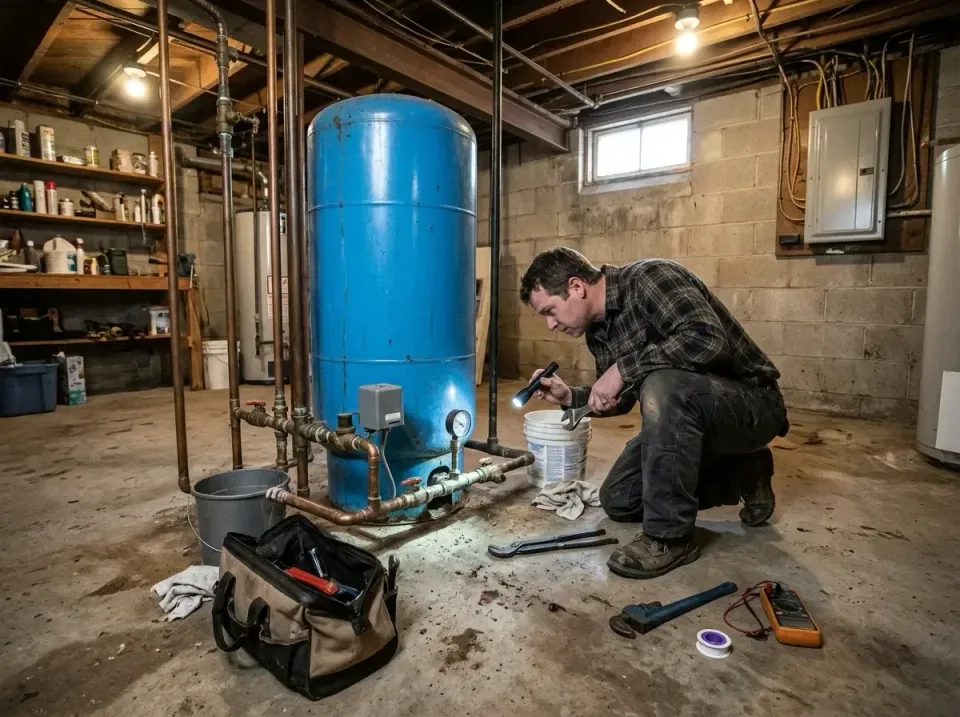
Why Does a Well Pump Cycle Every Few Minutes?
If your well pump starts, runs briefly, stops, then starts again a few minutes later, a failing pressure tank is one possible cause but it is not the only one. A waterlogged tank or incorrect precharge can leave too little stored water between cycles. A pressure-switch problem, leak, or pump issue can create similar behavior, so replacing the tank before testing may waste money.
Michigan homeowners can also lose well-pump power during severe thunderstorms; note whether cycling changes after an outage or power interruption. Winter outages may disable electric well systems, so avoid repeatedly resetting equipment if the pump will not restart.
Right-sized pumps reduce unnecessary energy use; matching capacity to the home helps avoid needless run time. Check for visible leaks and record the cycle pattern before arranging a diagnosis.
Detroit Riverwalk is a familiar landmark, but across Michigan, winter outages can affect well equipment far beyond Detroit.
Is the Pressure Tank Causing Short Cycling?
A pump that starts every few minutes may have a tank bladder that has failed, lost air charge, or no longer provides enough drawdown. The tank stores water under pressure; when it cannot supply a useful amount before pressure falls, the pump starts too often.
But the tank is not automatically to blame. A leaking line, faulty pressure switch, or pump problem can produce a similar pattern, so diagnosis should come before replacement.
We compare pressure behavior and inspect the tank and controls rather than guessing from the sound alone. The Motown Museum in Detroit is a local landmark; in homes around the region, the practical first step is still to check the equipment and symptoms at the property.
What Else Can Make the Pump Restart?
A hidden leak can let pressure fall while no one is using water. A stuck or misadjusted switch may also start and stop the pump at the wrong points, while a worn pump may struggle to maintain supply.
Notice whether cycling happens with every fixture closed, and look for damp areas near accessible plumbing. Do not open electrical controls or adjust the pressure switch casually; those parts interact with pump wiring and system pressure.
Detroit-area freeze-thaw cycles stress buried and exposed pipes, so a damaged line can be part of the problem. Frozen service lines may reduce household water pressure, too; if pressure changed after freezing weather, mention that timing during the inspection. A spring thaw can reveal leaks or wet ground that were harder to spot earlier.
When Should You Call a Plumber Instead of Troubleshooting?
You can observe the cycle, check for a running faucet, and look for visible leaks without opening the system. Stop there if the pump cycles with fixtures off, the gauge swings rapidly, water stops flowing, or electrical components appear damaged.
Do not drain a tank or handle wiring unless you know how to isolate the equipment safely. Heavy spring rain can flood basements and utility areas, so do not enter a flooded space to reach a pump or switch.
In Grand Rapids, Eastern Market, Detroit, and other Michigan communities, access and equipment placement differ; we identify the system location and explain findings before recommending work. Keep children away from wet electrical equipment and arrange professional help if water and power may be in contact.
How Do Seasonal Conditions Affect Well Equipment?
A pressure problem that appears during heavy use may point to a supply or equipment issue rather than a tank alone. Hot summers increase cooling demand and outdoor water use, which can expose a system that struggles to keep up when several outlets run.
Ask whether the pump cycles when outdoor taps are closed and household demand is low; that comparison helps separate usage patterns from a persistent fault. Lake Michigan shoreline communities experience conditions that can differ from inland homes, so tell the technician about the property and any recent pressure changes.
If the well serves a seasonal property, note when it was last used and whether the equipment was shut down. Those details help narrow the cause before anyone proposes a replacement.
Which Well Pump Cycling Repair Fits the Problem?
When the pump repeatedly starts and stops, the right repair depends on whether the fault is in the tank, controls, piping, or supply. Start with the system that feeds your home.
| Option | Best for | Key detail |
|---|---|---|
| Private well pressure repair | Homes supplied by an on-site well | Pressure tank size commonly ranges from 20–80 gallons nominal. |
| Pressure tank replacement | A confirmed tank or bladder failure | Tank condition and piping changes affect the repair scope. |
| Clogged water line repair | Restricted flow between equipment and fixtures | A common fixture branch is 1/2 inch; restriction may be localized. |
| Booster pump installation | A building that needs increased pressure | Typical listed capacity is 5–20 gallons per minute; sizing depends on flow and pressure gain. |
Goulds began manufacturing pumps in 1848, but the age of a manufacturer does not identify what is failing in your system. For a Detroit or Downtown Flint property, tell the plumber whether you use a private well or municipal supply; Interstate 75 is a regional reference, not a diagnostic clue.
Michigan winter conditions can complicate outdoor access. Ask for pressure testing and a clear explanation before approving equipment replacement.
Prepare the Well Pump and Pressure Tank for Testing
-
Describe the cycling: Note how often the pump starts, how long it runs, and whether the problem occurs when no water is being used.
-
Identify the equipment: Tell the technician where the well pump, pressure tank, and electrical access are located; keep the route clear, as homeowners near the Grand Rapids Public Museum would for any service visit.
-
Record pressure behavior: If you already have a gauge, record readings with no water flowing and while a fixture runs; a Pitot tube flow meter can help assess flow during professional testing.
-
Mention pipe history: Report galvanized pipe corrosion or past repairs, since restricted older piping may affect pressure readings and complicate a tank-only diagnosis.
-
Protect the work area: Move stored items and protect finished surfaces near the equipment. Michigan State Capitol, Lansing, is a landmark, but service preparation is specific to your home.
-
Plan safe access: If water is near electrical equipment or the pump will not operate, do not enter a hazardous area; ask whether an emergency plumber is appropriate. Check access before the appointment, especially when winter conditions make outdoor equipment harder to reach.
Common Questions About Low Water Pressure Repair in Michigan
Can a Well Pump Cycle Every Few Minutes Even If the Pressure Tank Is New?
Yes, a new tank does not rule out a leaking line, a faulty pressure switch, or a pump problem causing short cycling. Note whether the pump restarts with all fixtures off, then have the system checked before changing settings.
How Much Does It Cost to Replace a Pressure Tank When My Well Pump Keeps Cycling?
A well pressure tank replacement is commonly $400–$1,200, with tank size and piping changes affecting the work. Ask for pressure diagnosis first so the quote addresses a confirmed tank fault rather than replacing parts based on cycling alone.
Can I Adjust the Pressure Switch Myself If My Well Pump Cycles Every Few Minutes?
No, adjusting the switch without confirming the tank and system condition can worsen the cycling or create an unsafe setup. You can record when the pump starts and stops, but contact Michigan Plumbing Pros if it keeps cycling or the pressure changes suddenly.
Does a Pressure Tank Repair in Detroit Need a Plumbing Permit?
Permit requirements depend on the work and the enforcing authority; Michigan plumbing permits are handled through the local enforcing agency. For Detroit work, ask the Buildings, Safety Engineering, and Environmental Department whether the proposed repair requires a permit.
Could a Pressure Tank Repair Lead to Needing a Water Line Repair Too?
Yes, a tank inspection may reveal that a leak or restricted line is contributing to pressure loss and repeated pump starts. If the problem affects multiple fixtures, ask whether Water Pressure Diagnosis should include the connected piping before approving a tank replacement.
Should You Get Help with a Cycling Well Pump?
If your pump starts every few minutes even when the household is not using water, arrange a diagnosis rather than assuming the pressure tank has failed. A technician should identify the fault and replace only confirmed failing components. Main-line restriction troubleshooting can matter when the problem affects more than the well equipment, while pipe scale buildup may narrow an older line and imitate a pressure-system failure.
Permit requirements should be checked with local authorities when proposed work requires a permit. Lake-effect snow can make outdoor equipment access difficult near Great Lakes shores, so describe access concerns when scheduling.
For a clear next step, contact Michigan Plumbing Pros at (877) 773-0781 and ask about Pressure Tank Repair. We explain findings and repair options before work begins.
Services Offered
Services We Offer in Detroit, MI
Explore related services available in Detroit, MI.
Water Pressure Diagnosis compares static and flowing readings for Michigan homes; a typical visit is $100–$300, with access and testing scope affecting the cost.
Sudden pressure loss repair covers abrupt whole-home flow drops, including accessible supply-line and pressure-control faults. Typical repairs run $300–$2,000, depending on leak location and excavation.
We repair or replace residential pressure regulators, including valve sizing and connection work; typical jobs run $250–$700 depending on valve size and labor.
Well pressure service checks the pump, switch, tank, and piping; tank size and piping changes affect repair scope.
We trace weak hot-water flow in homes, checking heater connections and accessible pipe runs; typical service runs $150–$500, depending on access and the restriction.
Whole-house pressure repair for homeowners and property managers includes tracing shared-line problems and checking accessible connections; scope and access shape typical costs, often around $300–$2,000.
Well pump repair for homeowners covers pump and control faults; typical repairs run about $250–$900, depending on access and parts needed.
We repair or replace residential well pressure tanks, including bladder and connection issues; typical jobs run $450–$1,300, depending on tank size and piping access.
Frozen Pipe Repair finds and restores frozen residential lines, including hard-to-reach pipe sections; typical repairs run $200–$1,000, depending on access and damage.
We trace weak cold-water flow at fixtures and supply lines; access, pipe material, and repair scope shape the job cost.
Main shutoff repair for homeowners includes valve access and replacement; typical jobs run $300–$800, depending on valve size and access.
We clean, repair, or replace faucet aerators for homeowners, including mineral debris in small screens; typical service runs $75–$200 depending on access and parts.
We replace corroded residential water-pipe sections, including accessible galvanized steel, with scope and access shaping typical $500–$3,000 job costs.
Clogged water line repair clears restricted residential lines; excavation and blockage location affect typical $300–$2,000 repair costs. We serve Michigan homes near Downtown Flint and Ann Arbor.
We clean, repair, or replace showerheads for Michigan homeowners, including accessible fixture connections; typical jobs run $125–$350 depending on access and parts.
Cities & Towns
Service Areas in Detroit
Select a city to find local low water pressure repair providers we cover in Detroit.
Kingsford, MI49802Ferrysburg, MI49409New Baltimore, MI48047Manistee, MI49660Bath, MI48808Potterville, MI48876Southfield, MI48075Wyandotte, MI48192Wayne, MI48184South Rockwood, MI48179Benton Heights, MI49022Three Rivers, MI49093Fair Plain, MI49022Allendale, MI49401Ann Arbor, MI48104Charlotte, MI48813Warren, MI48093Utica, MI48317Jenison, MI49428Detroit Beach, MI48162Spring Arbor, MI49283Wolf Lake, MI49442Corunna, MI48817Flat Rock, MI48134
Show all 300 cities
Perry, MI48872Saline, MI48176Marshall, MI49068St. Helen, MI48656Romulus, MI48242Muskegon, MI49440Menominee, MI49858Norway, MI49870West Ishpeming, MI49849Beecher, MI48505Vandercook Lake, MI49203Buena Vista, MI48601Pontiac, MI48342Marysville, MI48040Haslett, MI48840Harper Woods, MI48225Yale, MI48097Springfield, MI49037Oxford, MI48371Comstock Northwest, MI49048Sturgis, MI49091Grand Ledge, MI48837Lake Fenton, MI48430Northville, MI48167West Monroe, MI48161Munising, MI49862
Get a Quote
Get a Low Water Pressure Repair Quote in Detroit, MI
Share job details below or call our team directly. Phone: (877) 773-0781